At approximately 7:15 p.m. on the stormy night of 28 December 1879, the central navigation spans of the Tay bridge collapsed into the Firth of Tay at Dundee, taking with them a train, 6 carriages and 75 souls to their fate.

At the time, a gale estimated at Beaufort force 10/11 was blowing down the Tay estuary at right angles to the bridge. The collapse of the bridge, only opened 19 months and passed safe by the Board of Trade, sent shock waves through the Victorian engineering profession and general public.
The disaster is one of the most famous bridge failures and to date it is still one of the worst structural engineering failures in the British Isles. Detailed accounts of the disaster are given by Prebble(G1) and Thomas(G2). A fully revised new edition of David Swinfen’s(G3) book on the disaster was published in 2016. The book, utilising recent research, addresses the questions: What caused the disaster and who was to blame. In addition, it examines the question of how many lives were lost.
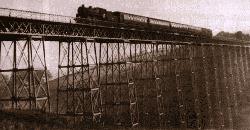
The first Tay rail bridge was completed in February 1878 to the design of Thomas Bouch. Bouch was responsible for the design, construction and maintenance of the bridge. Most of his bridges were lattice girders supported on slender cast iron columns braced with wrought iron struts and ties, such as the Belah Viaduct in the photograph to the right. The building of the Tay bridge culminated in him being knighted. A modern account of the life and work of Bouch is by Rapley(G4)

The Tay bridge was nearly two miles long, consisting of 85 spans and at the time was the longest bridge in the world. The spans carried a single rail track; 72 of these were supported on spanning girders below the level of the track; the remaining 13 navigation spans were spanning girders above the level of the track (i.e. the train runs through a tunnel of girders).
These “high girders”, as they were known, were 27 ft high with an 88 ft clearance above the high water mark. It was these spans which fell. Most of the girders below track level, all of which remained standing, were transferred to the present Tay rail bridge. At the time of the collapse Bouch was working on the design of the proposed Forth Bridge. In consequence, the design of the bridge was transferred to Benjamin Baker and Sir John Fowler.
A Court of Inquiry was set up to try and ascertain the reason for the collapse of the bridge. The Court of Inquiry report (T6) concluded that, “The fall of the bridge was occasioned by the insufficiency of the cross bracing and its fastenings to sustain the force of the gale.” The Court of Inquiry indicated that if the piers, and in particular the wind bracing, had been properly constructed and maintained, the bridge could have withstood the storm that night, albeit with a low factor of safety – 4 to 5 was the norm at the time.
Sir Thomas Bouch was held chiefly to blame for the collapse in not making adequate allowance for wind loading. He used a wind pressure of 10 lbsf/sq ft for the design of the Tay bridge. It is interesting to note that when working on the design of a proposed Forth bridge (1866) he used 30lbsf/sq ft(G4). To this day, however, there is still speculation as to the fundamental cause and as to whether the designer, Thomas Bouch, was to blame. A very readable account of the transcripts of the public enquiry is by Gren(G8)

Apart from the results of the original Court of Inquiry, various theories have been put proposed to explain the collapse. The picture shows the present Tay Rail bridge alongside the pier remains of Bouch’s bridge. It is a very emotive site and provides a grim reminder of the disaster. The wrought iron girders which remained standing after the disaster were transferred onto the present bridge where they are still in use today.
Researching the Tay bridge disaster has taken place over a period of 30 years resulting in 4 joint papers being published, three of which are available for download from the References section below.
The References section below now has a sub-section entitled General Introduction . In this sub-section, a paper by Robert Shiels and myself reviewing the historical and engineering literature is available for download. This paper is a very worth while read.
In addition, the References section below has a sub-section entitled Legal and medico-legal aspects of the Tay Bridge. In this sub-section, various downloadable papers/articles examine the disaster from a legal perspective.
References
General Introduction
GI1. Robert S. Shiels Tom J. Martin (2026) The Tay Bridge disaster of 1879: A general review of the historical and Engineering literature 2025.
General Books/Papers
G1. John Prebble (1979) The High Girders. Penguin.
G2. John Thomas (1970) The Tay Bridge Disaster David and Charles, Newton Abbot.
G3. David Swinfen (2016) The fall of the Tay Bridge, Birlinn Ltd.
G4. Roland Paxton (1990) 100 years of the Forth Bridge, Thomas Telford, London
G5. Jean Leslie, Roland Paxton Bright Lights, The Stevenson Engineers 1751-1971
G6. Stephen Cameron (2002), Colourpoint Books, Death in the North Channel: The Loss of the “Princess Victoria”, January 1953,
G7. John Rapley (2007), Tempus Publishing, Thomas Bouch, the builder of the Tay Bridge.
G8. Andre Gren (2006) Siver Link Publishing, The Bridge is Down: The Tay Bridge Disaster of 1879 as Reported in transcripts of the Public Enquiry.
G9. Robin Lumley (2013) The History Press. Tay Bridge Disaster: The People’s Story.
G10. Charles McKean (2006) Granta publications, Battle for the North, The Tay and Forth Bridges and the 19th -Century Railway Wars.
G11. Ian Henderson The British Approach to Disaster Management – A Fresh Look at the Tay Bridge Disaster 1879, (1998) Northern Scotland
G12. P. J. G. Ranson (2007) Iron Road: The Railway in Scotland, Berlinn Ltd.
G13. The Dundee Directory 1878-1879
G14. Simon Bradley (2024) Profile Books,Bradley’s Railway Guide: A journey through two centuries of British railway history, 1825-2025.
G15. David Wragg (2013) The Race to the North: Rivalry & Record-Breaking in the Golden Age of Stream, Wharncliffe Books.
G16. Murray Nicol, Clare Nicol & Grant Buttars (2005) Victims of the Tay Rail Bridge disaster of Sunday 28 December 1879, Tay Valley Family History Society.
G17. Carsten Weerth (2025) The Collapse of the Tay Bridge- Errors and limits of Technical Design Possibilities and Social Assessment from 1880 onward (German version), Fernuniversität Hagen.
G18. Carsten Weerth (2025) The Collapse of the Tay Bridge- Errors and limits of Technical Design Possibilities and Social Assessment from 1880 onward, Fernuniversität Hagen.
G19. Making Tracks to Dundee: 200 years of local railway history – talk by Dr. Kenneth Baxter on YouTube.
Technical Books/Papers/Articles
T1. Martin T. J. MacLeod I. A. (1990) The Tay Bridge Disaster – a study in structural pathology, Developments in Structural Engineering, Forth Rail Bridge Centenary Conference, Spon.
T2. Martin T. & MacLeod I. A. The Tay rail bridge disaster – A reappraisal based on modern analysis methods, Proc. Instn Civ. Engrs, 1995 ,108, 77-83
T3. Martin T. & MacLeod I. A. The Tay rail bridge disaster revisited, Proc. Instn Civ. Engrs, 2004 ,157, 187-192
T4. Martin T. J & MacLeod I. A. The legacy of the Tay Bridge collapse, IESIS Journal of Engineering Vol. 157.2018 ,108, 27-31
T5. Shipway J. S. (1989) Tay rail bridge centenary – some notes on its construction 1882-87 Proc. Instn Civ. Engrs Part 1, 86, Dec., 1089-1109
T6. Court of Inquiry (1880) Report upon the circumstances attending the fall of a portion of the Tay Bridge.
T7. W. M. Dow (1979) ‘Destined for disaster’, Scots Magazine, 275-186.
T8. Peter R. Lewis & Ken Reynolds (2002) Forensic Engineering: A Reappraisal of the Tay Bridge Disaster, reinvestigating the Tay Bridge disaster of 1879, Interdisciplinary Science Reviews, Vol 27, no 4.
T9. Peter R. Lewis (2004) Tempus Publishing, Beautiful railway bridge of the silvery Tay. Reinvestigating the Tay Bridge disaster of 1879.
T10. Colin R. Gagg & Peter R. Lewis. (2011) The rise and fall of cast iron in Victorian structures: a case study review. Engineering Failure Analysis, 18(8) pp. 1963-1980.
T11. Angus H. Cast Iron: physical and engineering properties . 2nd ed. Butterworth; 1976.
T12. Bjorn Akesson Understanding bridge collapses Taylor & Francis Group, London, UK; 2008
T14. A. Grothe The Tay Bridge Nature, 18, P: 361-368.
T15. Article in the Hannoverscher Courier by Professor Launhardt , “The Tay Bridge and the probable cause of its collapse”, Tuesday 6 January 1880, Morning edition, number 10113, page 5.
T16. Translation of the Article in the Hannoverscher Courier by Professor Launhardt, “The Tay Bridge and the probable cause of its collapse” by Nicola Wisdahl Dec 2021.
Meteorological Technical Papers/Articles
M1. Alexander Buchan The Tay Bridge storm of the 28th December 1879, Journal of the Meteorological Society, Vol 5 pp. 355-360
M2. Met. Office Edinburgh Met Office, Dundee records Dec. 1879
if you look at the image for reference M2 you will see that on the 28th December at 9 p. m. the record shows a wind strength of 6 and wind direction was from the west to the east.This was the only time in the life of the bridge when a 6 recorded (click right arrow below to see wind conversion table).
Wind strength conversion table
| Wind Strength (Met Office (1879) | Beaufort Scale | Description | Mean wind speed (M/Hr) |
| 0 | 0 | Calm | 0 |
| 1 | 1 | Light air | 2 |
| 2 | 5 | Fresh breeze | 5 |
| 3 | 6 | Strong breeze | 10 |
| 4 | 7 | Near gale | 35 |
| 5 | 8-9 | Gale(8) Strong gale(9) | 42 50 |
| 6 | 10-12 | Storm(10) Violent storm(11) Hurricane (12) | 59 68 >=73 |
M3. Robert H. Scott Note on the Report of Wind Force and Velocity during the Tay Bridge collapse
M4. P. J. A. Burt The Great Storm and the fall of the First Tay Rail Bridge, RMetS Weather-December 2004. Vol, 59 No 12
Legal and medico-legal aspects of the Tay Bridge
L1. Robert S. Shiels A Conflict of Interest at the Tay Bridge Disaster Inquiry (2022) Northern Scotland vol. 13(2), pp.213-6
L2. Robert S. Shiels Civil litigation and the construction of the new Tay Bridge, Scottish Law Agents 2024 17
L3. Robert S. Shiels The Tay Bridge disaster and the major personal injury claim Reparation Bulletin 2015, 122(Feb), 4-7
L4. Robert S. Shiels The investigation of sudden deaths and the Tay Bridge disaster of 1879 Juridical Review 2016, 3…
L5. Robert S. Shiels Scots law and the Tay Bridge disaster of 1879 Scots Law Times 2013, 40 , 271-274
L6. Robert S. Shiels Corporate governance, Financial risk and the Tay Bridge project Scottish Law Gazette 2024, 46.
L7. Robert S. Shiels The Tay Bridge disaster of 1879 and the role of the police
L8. Edinburgh Medical Journal, Post-mortem signs of drowning 1882 Apr; 27(10): 865–873
L9. Robert S. Shiels, ‘The Tay Bridge disaster of 1879 and Dundee solicitors’ Scottish Law Gazette, 2024 vol.92(4) pp. 118-122
L10. Robert S. Shiels, Sir Thomas Thornton Scottish Legal News 21/22 Nov. 2024
L11. Robert S. Shiels, David Dewar Chief Constable of Dundee City Police Scottish Legal News 21/22 Nov. 2024
L12. Robert S. Shiels, Enabling legislation relating specifically to the work for the construction of the Tay Bridge (2026)
Permission to reproduce the paper: Martin T. J & MacLeod I. A. The Tay rail bridge disaster – A reappraisal based on modern analysis methods, Proc. Instn Civ. Engrs, 1995 ,108, 77-83 in PDF format from the Institution of Civil Engineers is gratefully acknowledged.
Permission to reproduce the paper: Martin T. J & MacLeod I. A. The Tay rail bridge disaster revisited, Proc. Instn Civ. Engrs, 2004 ,157, 187-192 in PDF format from the Institution of Civil Engineers is gratefully acknowledged.
Permission to reproduce a pier image (showing uplift) from the Dundee City Council, Central Library, Photographic Collection is gratefully acknowledged.
Permission to reproduce clips from the podcast “The riddle of the Tay Bridge disaster” from the Open University is gratefully acknowledged.
Permission to reproduce the papers by Robert Shiels on legal aspects of the Tay Bridge project is gratefully acknowledged.
Permission to reproduce 2 pier images from Dr. P. R. Lewis Associates is gratefully acknowledged.
A copy of Mr Dow’s article in The Scots Magazine of 1979 has been provided for personal study only in this non-commercial website. For use of the attached article in anyway other than for such individual study an inquiry should be directed to DC Thomson, publishers, Dundee, Scotland.
 Tay Bridge disaster